Employment Law
What Is an HR Compliance Audit? A Practical UK Employer Checklist
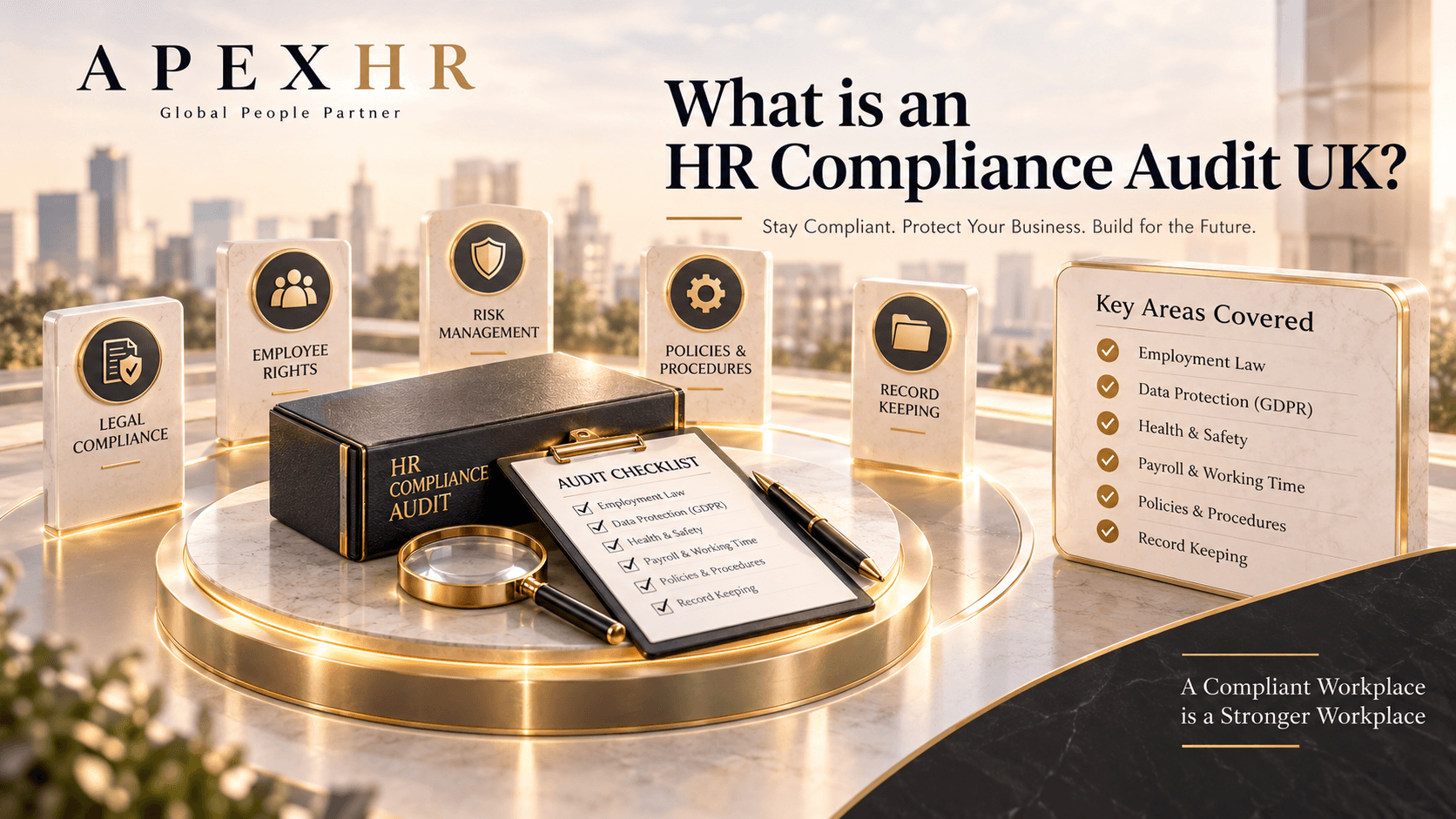
As businesses grow, managing employees involves more than recruitment and payroll. UK employers must maintain appropriate contracts, workplace policies, employee records, payroll processes, health and safety procedures and fair people-management practices. Over time, contracts may become outdated, policies may no longer reflect current practices, managers may handle employee issues inconsistently and important records may become […]
As businesses grow, managing employees involves more than recruitment and payroll. UK employers must maintain appropriate contracts, workplace policies, employee records, payroll processes, health and safety procedures and fair people-management practices. Over time, contracts may become outdated, policies may no longer reflect current practices, managers may handle employee issues inconsistently and important records may become difficult to manage.
This is where an HR compliance audit can help. An audit provides a structured review of employment contracts, HR policies, employee records and people-management practices to identify potential compliance gaps and areas for improvement. For UK employers, this may include working time, holiday pay, National Minimum Wage, right-to-work checks, employee relations, equality, data protection and other employment responsibilities.
Apex HR LLC provides HR compliance audit services for employers seeking a clearer understanding of their current HR position and a practical plan for addressing identified gaps. This guide explains the HR compliance audit process, provides a practical employer checklist, highlights common compliance risks and explores how professional HR support can help strengthen employment practices.
In This Guide
- What Is an HR Compliance Audit?
- Why Is an HR Compliance Audit Important?
- What Does an HR Compliance Audit Cover?
- A Practical UK Employer HR Compliance Checklist
- How to Conduct an HR Compliance Audit
- Common HR Compliance Mistakes UK Employers Make
- How Often Should a Business Conduct an HR Compliance Audit?
- Who Needs an HR Compliance Audit?
- HR Compliance Audit vs General HR Audit
- What Happens After an HR Compliance Audit?
- How Apex HR LLC Supports UK Employers
- FAQs About HR Compliance Audits
What Is an HR Compliance Audit?
An HR compliance audit is a systematic assessment of an organisation’s HR documents, employment procedures, employee records and workplace practices to identify potential gaps against relevant legal requirements and established HR standards.
The purpose is to establish whether the business has appropriate employment processes in place and whether those processes are being followed consistently.
For example, an organisation may have an employee handbook containing a disciplinary procedure. However, if managers do not follow the procedure when handling employee misconduct, the business may still face employee relations and procedural risks.
An HR compliance audit therefore examines both documentation and how HR processes operate in practice.
Depending on the scope, an audit may review:
- Employment contracts and written statements
- Employee handbooks
- HR policies and procedures
- Recruitment and onboarding
- Right-to-work checks
- Payroll and minimum wage processes
- Working hours and holiday records
- Statutory leave and sick pay
- Disciplinary and grievance procedures
- Equality and discrimination policies
- Workplace health and safety arrangements
- Employee records and data protection
- Termination and redundancy procedures
- HR responsibilities and management controls
The findings are generally organised into a report identifying gaps, potential risks and recommended corrective actions.
Importantly, an HR compliance audit is not automatically a legal audit, formal regulatory certification or guarantee that an organisation complies with every applicable law. Higher-risk matters may require review by a qualified employment solicitor.
Contact Apex HR LLC
Phone: +447762272692
Email: Hello@apexhrllc.co.uk
Address: London, United Kingdom
Website: Apex HR LLC
Why Is an HR Compliance Audit Important?
Many businesses assume that having an employment contract and a staff handbook means their HR practices are compliant.
However, compliance involves more than possessing the correct documents.
A business must also ensure that its policies reflect current requirements, records are maintained appropriately and managers understand how to apply workplace procedures.
Identify Employment Law Compliance Gaps
Employment legislation and associated guidance can change over time.
A policy written several years ago may no longer reflect current requirements or the organisation’s working arrangements.
An audit helps employers identify areas that require review before a problem arises.
Reduce Employee Relations Risks
Inconsistent disciplinary procedures, poorly documented grievances and unclear management responsibilities can create disputes.
A compliance audit can identify weaknesses in the processes used to handle employee concerns, misconduct, absence and performance issues.
Improve Employment Documentation
Contracts, written statements, policies and employee records should accurately reflect the organisation’s employment arrangements.
An audit can identify missing documents, outdated clauses, inconsistent terms and gaps in record-keeping.
Strengthen Management Accountability
Managers often make important decisions involving recruitment, performance, absence, conduct and employee exits.
An audit can establish whether managers understand their responsibilities and have appropriate guidance for handling these situations.
Prepare for Business Growth
Growing organisations frequently introduce new employees, departments, managers and locations.
Processes that worked for a small team may become difficult to manage consistently as the workforce expands.
An HR compliance audit helps employers establish whether their current HR framework can support that growth.
Support Organisational Due Diligence
Businesses preparing for investment, acquisition, restructuring or funding may need to demonstrate that their employment documentation and people-management processes have been reviewed.
An audit can provide documented findings and an action plan for addressing identified weaknesses.
What Does an HR Compliance Audit Cover?
The scope depends on the organisation’s workforce, industry, employment arrangements and current HR structure.
However, a practical UK HR compliance audit will usually examine several core areas.
Employment Contracts and Written Statements
Employers should review whether employees and workers have received the appropriate written statement of employment particulars and whether the information accurately reflects their terms.
The review should consider:
- Job title and responsibilities
- Start date
- Pay and payment frequency
- Working hours
- Holiday entitlement
- Sick pay arrangements
- Notice periods
- Probationary arrangements
- Workplace location
- Applicable policies and procedures
- Changes to contractual terms
The ACAS guide to written statements of employment particulars explains what employers must provide.
HR Policies and Employee Handbooks
Workplace policies should be current, accessible and consistent with the organisation’s actual practices.
An audit may examine:
- Disciplinary policy
- Grievance policy
- Absence management
- Sickness reporting
- Annual leave
- Flexible working
- Family leave
- Equality and diversity
- Bullying and harassment
- Whistleblowing
- Performance management
- Data protection
- Health and safety
Employers should also check whether staff know where to find these policies and whether managers apply them consistently.
Recruitment and Right-to-Work Checks
Recruitment compliance begins before an employee starts work.
Employers should review their recruitment procedures, candidate documentation and right-to-work verification processes.
This includes checking whether:
- Right-to-work checks are completed at the appropriate time.
- The correct checking method is used.
- Required evidence is retained.
- Follow-up checks are diarised where applicable.
- Recruitment decisions are handled consistently.
- Candidate information is managed appropriately.
- Recruitment processes avoid unlawful discrimination.
The Home Office right-to-work guidance provides detailed information on employer responsibilities.
Payroll, National Minimum Wage and Holiday Pay
Payroll is another important area of an HR compliance audit.
Employers should examine whether pay arrangements, deductions and working time records are accurate.
The review may cover:
- National Minimum Wage and National Living Wage
- Salary and hourly pay arrangements
- Overtime
- Working time
- Holiday entitlement
- Holiday pay calculations
- Statutory Sick Pay
- Family-related statutory payments
- Payroll deductions
- Pay records
Holiday pay deserves particular attention because the calculation may differ depending on the worker’s employment arrangement and pay structure.
Employers should also account for the requirement introduced from 6 April 2026 to retain adequate annual leave and holiday pay records for six years.
For further guidance, consult GOV.UK’s holiday pay guidance.
Working Time and Leave
A compliance review should establish whether working hours and leave arrangements are properly documented and administered.
Check:
- Working hours and shift patterns
- Rest breaks
- Daily and weekly rest
- Annual leave entitlement
- Holiday requests and approvals
- Bank holiday arrangements
- Maternity and paternity leave
- Adoption leave
- Shared parental leave
- Parental bereavement leave
- Other applicable statutory leave
- Absence records
Employers should also review whether their arrangements reflect the requirements applicable to their particular workforce.
Disciplinary and Grievance Procedures
Employee relations processes should be fair, documented and consistently applied.
An audit should examine whether the organisation has clear procedures for:
- Investigating misconduct
- Conducting disciplinary hearings
- Issuing warnings
- Handling grievances
- Managing appeals
- Recording decisions
- Maintaining confidentiality
- Escalating sensitive matters
The ACAS Code of Practice on disciplinary and grievance procedures provides an important reference for employers.
Equality, Discrimination and Workplace Harassment
Employers should assess whether their policies and workplace practices address discrimination, harassment and victimisation.
Review:
- Equality and diversity policies
- Recruitment criteria
- Promotion processes
- Reasonable adjustment procedures
- Bullying and harassment complaints
- Workplace investigation processes
- Equality-related training
- Management responsibilities
Employers should also review their arrangements for taking reasonable steps to prevent sexual harassment at work.
The Equality and Human Rights Commission’s guidance on sexual harassment provides further information.
Employee Records and Data Protection
Employee records often contain confidential personal information, including addresses, salary details, health information and performance records.
An audit should establish whether the organisation:
- Collects information for appropriate purposes.
- Maintains accurate employee records.
- Restricts access to authorised personnel.
- Has appropriate privacy information.
- Applies suitable retention periods.
- Protects confidential employee information.
- Handles employee data access requests appropriately.
- Has processes for managing data breaches.
The Information Commissioner’s Office guidance on employment records provides practical information for employers.
Health and Safety Responsibilities
Although an HR compliance audit is not a substitute for a specialist health and safety inspection, it can review the HR-related aspects of workplace safety.
This may include:
- Health and safety policies
- Employee induction
- Mandatory training records
- Accident reporting procedures
- Risk assessment responsibilities
- Display Screen Equipment arrangements
- Workplace adjustments
- Return-to-work procedures
- Relevant incident records
Employers should consult the Health and Safety Executive’s employer guidance for further information.
A Practical UK Employer HR Compliance Checklist
The following checklist can help employers organise an initial review of their HR position.
It is a practical starting point rather than an exhaustive legal compliance test. The requirements applicable to an organisation will depend on its workforce, industry and circumstances.
HR Compliance Audit Checklist
| Audit area | What employers should check |
| Employment contracts | Written statements are issued and terms are accurate |
| Employee handbook | Policies are current and accessible |
| Right to work | Checks are completed and evidence retained |
| Recruitment | Hiring procedures are consistent and documented |
| Payroll | Pay, deductions and statutory payments are reviewed |
| National Minimum Wage | Applicable pay requirements are met |
| Holiday entitlement | Leave calculations and records are accurate |
| Working time | Hours, rest breaks and relevant records are reviewed |
| Sickness absence | Reporting, sick pay and absence procedures are documented |
| Family leave | Relevant statutory leave and pay procedures are maintained |
| Disciplinary | Procedures reflect the ACAS Code and are followed |
| Grievances | Employees have a clear process for raising concerns |
| Equality | Policies and practices address discrimination |
| Harassment | Prevention, reporting and response arrangements are established |
| Employee data | Records are secure, accurate and appropriately retained |
| Health and safety | Relevant policies, training and records are maintained |
| Performance management | Reviews and performance procedures are documented |
| Employee exits | Resignation, dismissal and redundancy processes are reviewed |
| HR responsibilities | Managers understand their roles and escalation routes |
How to Record Audit Findings
A useful audit should go beyond marking items as complete or incomplete.
Employers can use a simple findings register:
| Area | Finding | Priority | Required action |
| Contracts | Some employee statements are outdated | High | Review and update documentation |
| Holiday records | Records are incomplete | High | Establish a consistent record-keeping process |
| Disciplinary | Managers use different procedures | Medium | Standardise guidance and provide training |
| Employee files | Access permissions are unclear | Medium | Review access controls |
| Training | Some records are missing | Medium | Confirm completed training and update records |
The priority levels above are illustrative. Actual risk should be assessed according to the legal requirement, potential impact, number of employees affected and urgency.
Recommended Articles
For a broader understanding of HR compliance, outsourcing and employment support, explore these related Apex HR LLC guides:
- What Are Outsourced HR Services and What Do They Include for UK Businesses?
- Outsource HR vs In-House HR for SMEs: Which Is More Cost-Effective?
- What HR Services Do Small Businesses Need in the UK?
- Top 15 HR Compliance Audit Consultants in the UK (2026)
How to Conduct an HR Compliance Audit
A structured approach makes the process easier to manage and helps ensure that findings lead to practical improvements.
Step 1: Establish the Scope of the Audit
Start by identifying what the organisation wants to review.
For example, a business may require a full HR compliance audit covering its employment lifecycle, while another may need a focused review of contracts, employee records or disciplinary procedures.
Consider:
- Number of employees
- Employment arrangements
- Number of locations
- Existing HR resources
- Industry-specific requirements
- Recent employee relations issues
- Planned business changes
The scope should be agreed before reviewing documentation.
Step 2: Collect Relevant HR Documents
Gather the documents and records required for the assessment.
These may include:
- Employment contracts
- Written statements
- Employee handbooks
- HR policies
- Payroll records
- Holiday records
- Recruitment documentation
- Right-to-work evidence
- Training records
- Disciplinary and grievance files
- Absence records
- Employee data policies
Access to sensitive information should be controlled throughout the process.
Step 3: Review Existing Policies and Procedures
Compare the organisation’s current documents with applicable requirements and recognised HR practice.
Identify missing policies, outdated wording, inconsistent terms and procedures that do not reflect actual working arrangements.
Step 4: Examine How HR Processes Work in Practice
A document review alone may not reveal operational weaknesses.
Speak with relevant managers or HR personnel to understand how procedures are applied.
For example:
- How are grievances received and investigated?
- Who approves holiday requests?
- How are right-to-work follow-up checks managed?
- How are employee records updated?
- What happens when a performance concern arises?
This helps distinguish between a documentation gap and a process that is not being followed.
Step 5: Identify and Prioritise Compliance Gaps
Record each finding clearly.
A useful audit report should distinguish between:
- Missing documentation
- Outdated policies
- Inconsistent practices
- Record-keeping weaknesses
- Potential legal exposure
- Management training requirements
- Matters requiring specialist legal advice
Prioritisation helps management determine which actions require immediate attention.
Step 6: Develop a Corrective Action Plan
Each identified issue should have a corresponding action.
For example:
| Action | Responsibility | Target date |
| Update employment documentation | HR | Agreed deadline |
| Review holiday records | HR / Payroll | Agreed deadline |
| Update disciplinary procedure | HR | Agreed deadline |
| Train line managers | HR / Management | Agreed deadline |
| Review employee data access | HR / IT | Agreed deadline |
Assigning ownership prevents the audit from becoming a report that is completed but never acted upon.
Step 7: Monitor Progress and Review Again
Once corrective actions have been implemented, the organisation should confirm that the changes are working.
This may involve reviewing updated documents, checking records, speaking with managers and establishing regular compliance reviews.
For employers requiring ongoing assistance, retained HR support can help maintain the improvements beyond the initial audit.
Common HR Compliance Mistakes UK Employers Make
Even businesses with established HR departments can experience compliance gaps.
Some common examples include:
Using Outdated Employment Contracts
Contracts may not reflect changes in job responsibilities, working hours, benefits or applicable employment requirements.
Employers should review documentation periodically and when significant changes occur.
Treating an Employee Handbook as a Complete Compliance Solution
A handbook is useful, but it cannot replace appropriate employment records, effective management procedures or consistent implementation.
Inconsistent Disciplinary Procedures
Managers may handle similar employee issues differently, creating procedural and employee relations risks.
Clear guidance and manager training can help establish consistency.
Incomplete Holiday and Working Time Records
Businesses may rely on informal spreadsheets or inconsistent systems that make it difficult to establish accurate entitlement and payment records.
Poor Employee Record Management
Employee information may be stored across personal devices, email accounts or disconnected systems.
This can create difficulties with access control, accuracy, retention and accountability.
Failing to Review HR Practices as the Business Grows
A business may continue using informal procedures even after its workforce and management structure have become more complex.
An audit can help identify where additional HR infrastructure is required.
How Often Should a Business Conduct an HR Compliance Audit?
There is no universal statutory frequency requiring every UK employer to conduct a complete HR compliance audit annually.
However, many organisations choose to review their HR arrangements periodically and whenever significant changes occur.
An audit may be appropriate:
- During an annual HR review
- Before a major recruitment programme
- Following rapid workforce growth
- Before an acquisition or investment
- During restructuring
- After significant employee relations issues
- When employment requirements change
- When new HR systems are introduced
- When existing policies have not been reviewed for several years
For some employers, an annual comprehensive review combined with smaller quarterly checks may be suitable.
The appropriate frequency depends on the organisation’s size, workforce complexity, sector and exposure to employment-related risks.
Who Needs an HR Compliance Audit?
An HR compliance audit can be relevant to businesses at different stages of development.
Small Businesses
Small businesses may rely on founders, office managers or finance personnel to handle HR responsibilities.
An audit can help establish whether essential documentation, employee records and workplace procedures are in place.
Growing SMEs
As an SME expands, its HR requirements often become more complex.
A compliance audit can help identify gaps before they affect a larger workforce.
Businesses With an Existing HR Team
An internal HR department may manage daily employee matters effectively but still benefit from an independent review of its documentation, processes and compliance controls.
Multi-Site Employers
Businesses operating across different locations may need to check whether HR procedures are applied consistently.
Businesses Preparing for Investment or Restructuring
An audit can help identify employment documentation and people-management issues that should be addressed as part of wider organisational preparation.
HR Compliance Audit vs General HR Audit
Although the terms are sometimes used interchangeably, the scope can differ.
| Factor | HR Compliance Audit | General HR Audit |
| Main focus | Employment requirements, documentation and process gaps | Overall effectiveness of the HR function |
| Legal compliance | Central consideration | One component |
| Policies and contracts | Reviewed for gaps and accuracy | Reviewed alongside wider HR strategy |
| Employee relations | Procedures and records | Wider management effectiveness |
| Workforce planning | May be outside the core scope | Often included |
| Employee engagement | Usually limited | May be examined |
| Main outcome | Findings and corrective action plan | Broader HR improvement recommendations |
A business that is primarily concerned about employment documentation and procedural risk may begin with a compliance audit.
An organisation looking to improve its wider people strategy may require a broader HR review.
What Happens After an HR Compliance Audit?
The value of an audit depends on what happens after the findings are delivered.
A typical outcome includes a written report identifying:
- Areas reviewed
- Documents and processes assessed
- Compliance gaps
- Potential risks
- Priority recommendations
- Required corrective actions
- Suggested implementation timelines
Depending on the engagement, employers may also receive support with:
- Updating employment contracts
- Revising employee handbooks
- Developing HR policies
- Improving employee record management
- Standardising disciplinary and grievance procedures
- Training managers
- Establishing ongoing HR review processes
Some findings may require additional specialist employment law advice.
The objective is to turn the review into a practical improvement programme rather than simply produce a list of problems.
How Apex HR LLC Supports UK Employers
For employers, identifying an HR compliance gap is only the beginning. The next challenge is understanding what needs to change, which actions should be prioritised and how improvements can be implemented without disrupting everyday operations.
Apex HR LLC provides HR compliance audit support for UK employers seeking a practical review of their employment documentation, policies and people-management processes.
Its approach focuses on identifying gaps, explaining findings and helping businesses establish a clear action plan.
Practical Review of HR Documents and Processes
Apex HR LLC’s HR Compliance Audit service can include:
- Reviewing employment contracts and policies
- Examining key HR processes
- Identifying gaps against good-practice HR standards
- Preparing a prioritised findings report
- Recommending practical corrective actions
- Providing optional implementation support
Support Tailored to Your Business
Different organisations face different HR challenges.
A startup establishing its first formal employment policies will have different requirements from an established SME reviewing employee relations procedures or a growing organisation preparing for expansion.
Apex HR LLC can tailor the audit scope to the employer’s workforce, existing HR arrangements and business priorities.
Support Beyond the Audit
Some businesses require a defined review, while others need ongoing HR support after the initial findings have been addressed.
Depending on the requirements, employers can also explore:
- Retained HR Services
- HR Support for Small Businesses and Startups
- Employee Handbooks & HR Policies
- Fractional HR Director / Chief People Officer
- Payroll Advisory
For employers who need continued support, Apex HR LLC’s Outsourced HR Services provide a broader route to ongoing HR advice and people-management support.
Arrange an HR Compliance Audit With Apex HR LLC
Are your employment contracts, workplace policies and HR procedures still appropriate for your business?
If you have not reviewed your HR framework recently, you may be carrying gaps that are difficult to identify through everyday management alone.
Apex HR LLC helps UK employers review their HR practices, identify potential compliance weaknesses and establish a prioritised plan for improvement.
Whether you are a small business establishing formal HR processes, an SME preparing for growth or an established organisation reviewing its employment documentation, the audit can be tailored to your requirements.
Do not wait for a grievance, employment dispute or documentation problem to expose weaknesses in your HR processes.
Explore Apex HR LLC’s HR Compliance Audit Service to understand how a structured review can help your organisation identify gaps and plan corrective action.
For a wider range of HR and people-management solutions, visit the Apex HR LLC Services page.
Ready to discuss your organisation’s HR compliance requirements?
Contact Apex HR LLC to discuss your current HR challenges, the areas you want reviewed and the type of support your business may require.
Phone: +44 7762 272692
Email: Hello@apexhrllc.co.uk
Location: London, United Kingdom
FAQs About What Is an HR Compliance Audit? A Practical UK Employer Checklist
1. What is an HR compliance audit?
An HR compliance audit is a structured review of an organisation’s employment documents, HR policies, employee records and people-management procedures to identify potential gaps against applicable employment requirements and good HR practice.
2. Why should a UK employer conduct an HR compliance audit?
An audit can help employers identify outdated contracts, missing documentation, inconsistent procedures, record-keeping weaknesses and potential employment-related risks. It also provides a structured action plan for addressing findings.
3. What documents are checked during an HR compliance audit?
Common documents include employment contracts, written statements, employee handbooks, HR policies, payroll records, holiday records, right-to-work evidence, employee files, training records and disciplinary or grievance documentation.
4. Is an HR compliance audit a legal requirement in the UK?
There is no general statutory requirement for every UK employer to commission a complete HR compliance audit. However, employers must meet the specific employment, record-keeping and workplace obligations that apply to their organisation.
5. How often should an HR compliance audit be conducted?
Many businesses choose to conduct a comprehensive review annually or when significant changes occur. Smaller reviews may also be appropriate following workforce growth, restructuring, changes in employment requirements or employee relations concerns.
6. How long does an HR compliance audit take?
The timeframe depends on employee numbers, the volume of documentation, the number of locations and the scope of the review. A focused review may require less time than a comprehensive assessment of a complex organisation.
7. Can a small business conduct its own HR compliance audit?
Yes. A small business can begin with a structured checklist covering contracts, policies, right-to-work checks, payroll, leave, employee records and workplace procedures. However, professional HR support may be useful when identifying complex gaps or developing corrective actions.
8. What happens if an HR compliance audit identifies problems?
The employer should document each finding, assess its urgency, assign responsibility and establish a corrective action plan. Depending on the issue, this may involve updating policies, correcting records, improving procedures, training managers or obtaining specialist legal advice.
9. Does an HR compliance audit guarantee that a business is legally compliant?
No. An audit provides an assessment based on the documents, information and processes reviewed. It is not formal legal certification or a guarantee of compliance. Employers may need further legal advice for complex or high-risk matters.
10. Can Apex HR LLC help implement audit recommendations?
Apex HR LLC offers optional implementation support alongside its HR compliance audit service. Depending on the agreed scope, this may include assistance with employment documentation, HR policies and improvements to people-management processes.
More insights
Related reading
HR Consultancy
Cost of Permanent Recruitment in Liverpool: UK Pricing, Fees and What Affects the Price
The cost of permanent recruitment in Liverpool through Apex HR LLC depends on the vacancy, the complexity of the search and the level of recruitment support your business requires. Apex HR LLC provides permanent recruitment support covering role definition, candidate sourcing, screening, shortlisting, interview support, offers and onboarding guidance. Apex HR LLC does not publish […]
HR Consultancy
Cost of Recruitment and Talent Acquisition Services in Leeds: Fees, Models and Hiring Costs
Businesses in Leeds need to consider more than salaries when budgeting for new employees. Recruitment agency fees, advertising, candidate screening and onboarding can all increase hiring costs. Apex HR LLC helps businesses approach recruitment and wider people management strategically, with support tailored to their workforce needs. This guide explains recruitment fees in Leeds, common pricing […]
Employee Handbooks
What Should an Employee Handbook Include in the UK?
An employee handbook is one of the most important documents a UK business can have. It sets out workplace expectations, employee rights, company policies, procedures and standards of behaviour, helping businesses create consistency, support managers and reduce misunderstandings. With support from an experienced HR provider such as Apex HR LLC, businesses can develop tailored employee […]
Talk to Apex HR about your workforce
Whether this raised a question or a decision you're facing, an adviser can help you think it through.