HR Services in the UK
Outsourced HR vs In-House HR for SMEs: Which Is More Cost-Effective?
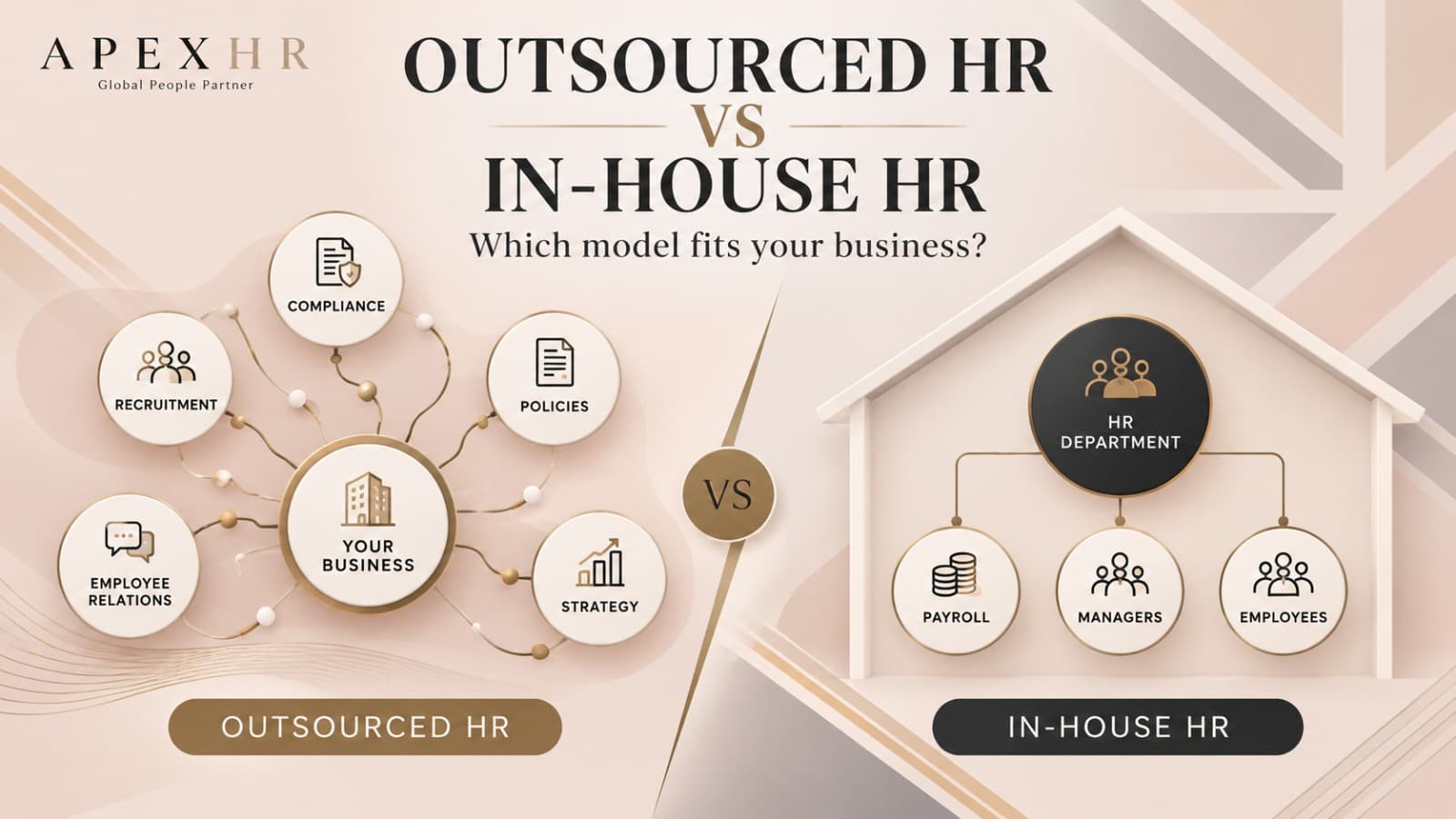
Small and medium-sized enterprises (SMEs) need reliable HR support as they recruit employees, manage workplace issues, develop policies and respond to changing employment requirements. The challenge is deciding how that support should be delivered. Some SMEs use outsourced HR services, working with an external provider for ongoing HR advice, employee relations, recruitment, compliance and strategic […]
Small and medium-sized enterprises (SMEs) need reliable HR support as they recruit employees, manage workplace issues, develop policies and respond to changing employment requirements. The challenge is deciding how that support should be delivered.
Some SMEs use outsourced HR services, working with an external provider for ongoing HR advice, employee relations, recruitment, compliance and strategic support. Others employ HR professionals directly and build an in-house HR function. A third option is a hybrid or co-sourced model, where an internal HR employee or team works alongside an external provider.
The cost-effective option depends on what the business actually needs. An outsourced HR arrangement may reduce fixed employment costs and provide access to wider expertise, while an in-house HR function can offer greater day-to-day presence and deeper internal knowledge.
What Is Outsourced HR?
Outsourced HR means using an external HR provider to deliver some or all of an organisation’s HR requirements.
The scope can range from occasional HR advice to an ongoing retained partnership covering day-to-day HR management and strategic people support.
Depending on the provider and agreement, outsourced HR may include:
- HR advice and consultancy
- Employment documentation
- HR policies and employee handbooks
- Employee relations
- Disciplinary and grievance support
- Absence management
- Recruitment and talent acquisition
- Performance management
- HR compliance
- Payroll advisory
- Learning and development
- Workforce planning
- Organisational development
- HR technology
- People analytics
- Strategic HR advice
There is no single standard definition of outsourced HR. The services included, response times, pricing and level of involvement can vary significantly between providers.
The CIPD identifies access to expertise and potential efficiency gains as benefits of outsourcing, while also highlighting possible challenges such as loss of in-house knowledge and fragmented HR services. Payroll is currently the most commonly outsourced HR activity, followed by specialist advice.
For further background, see the CIPD’s guidance on HR outsourcing.
How Does Outsourced HR Work?
An SME normally starts by identifying the HR responsibilities it needs help with.
The provider and business can then agree on:
- Services included
- Level of HR support
- Communication arrangements
- Response times
- Pricing
- Reporting
- Confidentiality and data handling
- Responsibilities of each party
- Additional services and charges
Support can be structured in several ways, including:
Project support: Help with a defined HR project or outcome.
Ad hoc consultancy: HR advice when a specific issue arises.
Retained HR: Ongoing access to HR advice and support for an agreed recurring fee.
Interim or fractional HR: Additional HR leadership or delivery capacity for a defined period or number of days.
Apex HR LLC currently offers project, retained and interim or fractional arrangements, allowing support to be structured around the organisation’s requirements.
Contact Apex HR LLC
Phone: +447762272692
Email: Hello@apexhrllc.co.uk
Address: London, United Kingdom
Website: Apex HR LLC
What Is In-House HR?
In-house HR means HR responsibilities are primarily handled by employees who work directly for the organisation.
Depending on the size and complexity of the business, an internal HR function could include:
- HR administrator
- HR officer
- HR adviser
- HR manager
- HR business partner
- Head of HR
- HR director
- Specialist HR professionals
A smaller SME may begin with one HR generalist handling a broad range of responsibilities. As the organisation grows, it may add specialists in recruitment, employee relations, learning and development, reward or organisational development.
One of the main differences from outsourced HR is the level of internal presence. An in-house HR professional works directly within the organisation and can develop detailed knowledge of its employees, managers, culture, processes and business objectives.
However, employing an HR professional does not transfer the employer’s legal responsibilities to that individual. The organisation remains responsible for ensuring its employment practices and processes are appropriate.
For example, Acas explains that an employment contract is broader than the written statement of employment particulars, and employers must provide the written statement on or before the first day of work.
Outsourced HR vs In-House HR: Key Differences
Both models can provide effective HR support, but they operate differently.
| Factor | Outsourced HR | In-House HR |
| Employment model | External provider | Direct employee or internal team |
| Cost structure | Retainer, project, hourly, daily or bespoke | Salary plus employment costs and overheads |
| Expertise | Potential access to multiple specialists | Dependent on internal team |
| Internal presence | Depends on arrangement | Direct day-to-day presence |
| Business knowledge | Develops through the relationship | Built internally over time |
| Flexibility | Scope can often change with requirements | Changes may require recruitment or restructuring |
| Specialist support | May be available across several disciplines | May require additional employees or external specialists |
| Recruitment | No HR-specific recruitment required | Business recruits and employs HR staff |
| Training | Provider manages its own professional development | Employer funds employee development |
| Scalability | Can potentially increase or reduce support | Usually linked to headcount and internal capacity |
| Knowledge retention | Some HR knowledge remains with provider | Knowledge remains within the organisation |
| Strategic support | Can be included depending on agreement | Developed within the internal function |
Neither model is automatically more cost-effective.
The right comparison is whether the business is receiving the level of HR capability it needs for the total cost it is prepared to pay.
What Does Outsourced HR Typically Cover?
An SME does not need to outsource its entire HR function. It can outsource specific responsibilities while keeping other activities internally.
HR Advice and Consultancy
External HR professionals can advise business owners and managers on employment-related decisions, workplace procedures and people management.
This can be particularly useful where an organisation has managers handling HR responsibilities but no dedicated HR specialist.
Employment Contracts and HR Documentation
External HR support can help businesses prepare, review and update employment documentation.
Acas explains that employers must provide a written statement of employment particulars on or before the first day of work, while some additional information can be provided later within specified time limits.
Businesses can refer to Acas guidance on employment contracts and the law when reviewing their arrangements.
HR Policies and Employee Handbooks
An outsourced provider may help SMEs create, review and update policies covering areas such as:
- Absence
- Flexible working
- Disciplinary procedures
- Grievances
- Employee conduct
- Family leave
- Performance
- Remote working
- Workplace behaviour
The aim should be to develop policies that reflect the organisation rather than relying on generic documents without considering how they will work in practice.
Employee Relations
Employee relations support may cover:
- Disciplinary matters
- Grievances
- Workplace conflict
- Performance concerns
- Difficult conversations
- Investigations
- Manager guidance
- Formal HR procedures
For SMEs without an experienced HR professional internally, external support can provide additional guidance when sensitive employee issues arise.
Recruitment and Talent Acquisition
Recruitment is another area that can be outsourced, particularly where a business needs additional hiring capacity or specialist recruitment expertise.
Support may include:
- Workforce requirements
- Job descriptions
- Candidate attraction
- Screening
- Interviews
- Selection
- References
- Offers
- Onboarding
Recruitment also involves processing candidates’ personal information. The ICO provides guidance on data protection throughout recruitment and selection.
See the ICO guidance on recruitment and selection for further information.
Apex HR LLC’s current recruitment offering includes permanent recruitment, executive search, contract staffing and recruitment process outsourcing.
Performance and Talent Management
External HR support can help SMEs establish more consistent approaches to:
- Performance reviews
- Objective setting
- Performance improvement
- Talent reviews
- Succession planning
- Career development
Compensation, Reward and Benefits
External expertise can also support:
- Salary benchmarking
- Job evaluation
- Reward structures
- Benefits
- Compensation strategy
This can be useful when an SME needs specialist reward expertise but does not require a permanent reward professional.
HR Compliance
HR providers can help businesses review contracts, policies and people processes and identify areas that may need attention.
However, HR consultancy should not be treated as a substitute for specialist legal advice where legal interpretation or representation is required.
Workforce Planning and Strategic HR
More comprehensive outsourced arrangements can also cover:
- Workforce planning
- Organisational design
- Organisational development
- Change management
- Succession planning
- People strategy
- Leadership development
This can help an SME move beyond reactive HR administration and develop a more structured approach to its workforce.
For organisations considering a broader outsourced arrangement, Apex HR LLC’s guide on what outsourced HR services include for UK businesses provides further context.
What Does an In-House HR Team Typically Handle?
An internal HR function can cover many of the same responsibilities as an outsourced provider.
Employee Administration
An internal HR team may manage:
- Employee records
- Contracts and documentation
- Absence records
- Holiday administration
- HR systems
- Routine employee queries
Because HR teams handle personal information, businesses also need appropriate processes for accessing, storing and protecting employee data.
Recruitment
An internal team can manage recruitment from vacancy creation through to onboarding.
Employee Relations
Internal HR professionals can work directly with managers and employees on:
- Workplace concerns
- Disciplinary matters
- Grievances
- Conflict
- Performance issues
- Investigations
Performance and Talent
An internal team can establish performance processes, support managers, coordinate reviews and contribute to succession and talent planning.
Learning and Development
HR may also coordinate:
- Training
- Management development
- Leadership programmes
- Coaching
- Career development
- Skills development
Strategic HR
As the organisation grows, the internal HR function may become involved in:
- Workforce planning
- Organisational development
- Employee experience
- Reward
- Talent management
- Culture
- Business planning
What Are the Benefits of Outsourced HR for SMEs?
Access to Wider Expertise
An outsourced provider may give an SME access to professionals with experience across several HR disciplines.
Instead of employing one HR generalist and relying on external support whenever specialist knowledge is needed, the organisation may be able to access different areas of expertise through one provider.
Flexible Support
An outsourced arrangement can be structured around the organisation’s actual requirements.
For example, an SME may need occasional advice initially and then increase its level of support as recruitment, employee relations or workforce planning requirements grow.
Lower Fixed Headcount Commitment
Outsourcing can allow a business to access HR capability without immediately creating a permanent HR position or larger internal team.
This does not mean outsourcing will always be cheaper. It simply changes the cost structure from direct employment to an external service arrangement.
Specialist Support When Required
An external provider may offer access to expertise in areas such as:
- Employee relations
- Recruitment
- Reward
- Organisational development
- Workforce planning
- HR technology
- People analytics
Scalability
External support can potentially be increased or reduced as business requirements change, depending on the agreement.
Additional Management Capacity
For smaller businesses, founders and managers often have to handle HR alongside their main responsibilities.
External HR support can reduce the amount of HR work that managers need to manage themselves while providing access to professional guidance.
What Are the Benefits of In-House HR for SMEs?
Strong Organisational Knowledge
An internal HR professional can develop detailed knowledge of employees, managers, culture, systems and business processes.
Immediate Internal Access
Employees and managers have a dedicated internal HR contact who is part of the organisation.
Established Internal Relationships
An HR professional working within the business can build relationships with managers and employees over time.
Direct Control
The organisation has direct control over its HR team’s priorities, processes and systems.
Embedded Strategic Support
An internal HR professional can participate directly in leadership discussions and business planning.
Retention of Knowledge
Knowledge about the organisation’s people, processes and history stays within the business rather than sitting primarily with an external provider.
What Are the Potential Drawbacks of Outsourced HR?
Outsourcing can provide flexibility and expertise, but SMEs should consider its limitations.
Less Day-to-Day Internal Presence
An external provider may not be physically present in the organisation every day.
Provider Availability
Response times and availability depend on the service agreement.
Scope Restrictions
The business needs to understand exactly what is included and what may be charged separately.
Less Embedded Knowledge
An external provider may need time to understand the organisation, its people and its culture.
Data Protection Responsibilities
Where employee information is shared with an external provider, the organisation needs to understand the relevant data-processing, confidentiality and security arrangements.
Potential Loss of Internal Knowledge
The CIPD identifies loss of in-house knowledge and processes as one of the potential challenges of HR outsourcing.
What Are the Potential Drawbacks of In-House HR?
Ongoing Employment Costs
An internal HR employee creates ongoing employment costs. Depending on the role, these may include:
- Salary
- Employer National Insurance
- Pension contributions
- Benefits
- Recruitment
- Training
- Professional development
- HR technology
- Equipment
Recruitment and Retention
The organisation must recruit, retain and develop suitable HR professionals.
Limited Specialist Capacity
One HR generalist may not have deep expertise across every HR discipline.
Cover and Continuity
If the organisation depends heavily on one HR employee, sickness, annual leave or employee turnover can temporarily reduce HR capacity.
Additional Headcount as Requirements Grow
A business may eventually need additional HR specialists as its workforce and people requirements become more complex.
Is Outsourced HR Cheaper Than In-House HR?
Not necessarily.
Outsourced HR can be more cost-effective when a business needs professional HR support but does not require enough ongoing work to justify a permanent internal HR function.
However, an in-house HR function may make financial and operational sense when the organisation has a substantial and consistent volume of HR activity that requires dedicated internal capacity.
The key is to compare total cost against actual capability.
The Total Cost of In-House HR
An SME should consider more than the advertised salary.
Potential costs include:
- Salary
- Employer National Insurance
- Pension contributions
- Benefits
- Recruitment
- Onboarding
- Training
- Professional development
- HR software
- Equipment
- Management time
- Holiday and sickness cover
The Total Cost of Outsourced HR
The external arrangement may include:
- Monthly retainer
- Hourly or daily consultancy
- Project fees
- Additional specialist services
- Implementation costs
- Software or platform charges, where applicable
The important question is therefore not:
“Which option has the lower headline price?”
Instead, ask:
“Which option gives the business the HR capability it needs for the total cost involved?”
CIPD recommends considering the wider business case when assessing whether HR outsourcing is appropriate rather than looking at price alone.
What Affects the Cost of Outsourced HR?
There is no single UK-wide price for outsourced HR because providers offer very different levels of support.
Current market examples show pricing can range from relatively light-touch monthly retainers to much more comprehensive arrangements, while project and specialist work may be charged separately.
The main factors affecting cost include:
Number of Employees
Larger workforces may require more HR support, although headcount should not be used on its own to determine the appropriate model.
Scope of Services
A business requiring occasional advice will have different requirements from one outsourcing employee relations, recruitment, compliance and workforce planning.
Frequency of Support
Regular HR involvement will generally require a different arrangement from occasional consultancy.
Complexity
Factors such as rapid growth, multiple locations, complex employee relations matters or organisational change can increase the level of HR support required.
Pricing Structure
Providers may charge through:
- Monthly retainers
- Hourly rates
- Daily rates
- Fixed project fees
- Per-employee pricing
- Bespoke arrangements
Seniority Required
A business requiring senior HR leadership or fractional executive support may have different costs from one needing routine HR administration.
Additional Services
SMEs should establish whether services such as recruitment, investigations, training, restructuring or specialist employment support are included in the core fee.
What Affects the Cost of In-House HR?
Salary and Seniority
The salary depends on the role, experience, location and responsibilities.
Employer Costs
The real cost of employment extends beyond basic salary.
Recruitment
The business may incur recruitment, advertising or agency costs when hiring an HR professional.
Training and Development
HR professionals need ongoing professional development to maintain their knowledge and capabilities.
Technology
An internal HR function may require HRIS, recruitment, payroll, document management or people analytics systems.
Cover
Businesses should consider how HR responsibilities will be covered during annual leave, sickness or employee turnover.
Future Headcount
If HR requirements increase, the organisation may need to recruit additional HR professionals or specialists.
When Should an SME Consider Outsourced HR?
Outsourced HR may be worth considering when an SME:
- Does not have an internal HR department
- Needs regular HR support but not necessarily a full-time HR employee
- Needs access to several areas of expertise
- Is growing and its HR requirements are becoming more complex
- Has limited management capacity
- Needs support with employee relations
- Requires help with contracts and policies
- Needs recruitment support
- Requires workforce planning
- Wants strategic HR expertise without building a large internal team
For example, an SME may have enough HR activity to require professional support but not enough consistent workload to justify employing several HR specialists.
In that situation, an outsourced or retained arrangement can provide access to broader expertise while allowing the organisation to keep its internal headcount focused on its core operations.
When Might In-House HR Be Appropriate?
An internal HR function may be worth considering where a business:
- Needs HR support every working day
- Has a substantial and consistent HR workload
- Requires a dedicated internal HR presence
- Has complex organisational structures
- Wants HR closely embedded within leadership
- Has significant internal HR administration
- Wants to build a dedicated people function
- Has sufficient ongoing workload to support permanent HR headcount
There is no universal employee number at which a business should move in-house.
The decision should reflect the volume of HR work, level of complexity, need for internal presence and total cost of the required capability.
Can SMEs Combine Outsourced and In-House HR?
Yes.
A hybrid or co-sourced HR model combines internal HR resources with external expertise.
For example, an SME could:
- Employ an internal HR manager
- Outsource complex employee relations cases
- Use an external provider for recruitment
- Outsource payroll
- Bring in specialist reward expertise
- Use external support for workforce planning
- Obtain HR technology support
- Engage fractional senior HR leadership
This can allow an organisation to retain internal HR ownership while accessing specialist expertise when required.
It can also be useful when a business is growing. An internal HR professional may handle day-to-day employee matters while an external provider provides additional capacity during periods of recruitment, restructuring, transformation or strategic planning.
Apex HR LLC currently offers retained, project, interim and fractional support, meaning an external engagement does not necessarily have to replace an existing HR team.
For SMEs considering different forms of external support, the guide to small business HR support companies in the UK provides a broader look at the options available to employers.
How to Choose Between Outsourced and In-House HR
Before making a decision, SMEs should assess several practical factors.
1. How Much HR Work Do You Have?
Look at how much time managers currently spend on:
- HR queries
- Recruitment
- Documentation
- Employee relations
- Performance
- Absence
- Policies
- Compliance
If HR work is occasional, a full-time internal role may provide more capacity than the business actually needs.
2. What Expertise Do You Need?
Consider whether you need one generalist or access to several specialist disciplines.
For example, an organisation may need employee relations support, recruitment expertise, reward advice and workforce planning at different points.
3. How Important Is Internal Presence?
If employees need a dedicated HR professional available internally every day, an in-house function may offer advantages.
If specialist support is more important than physical presence, outsourcing may provide greater flexibility.
4. What Is the Total Cost?
Compare the complete cost of internal employment against the full cost of the external arrangement.
Do not compare an outsourced monthly fee with salary alone.
5. How Quickly Is the Business Growing?
A rapidly growing organisation may need an HR model that can increase capacity without requiring repeated recruitment.
6. How Complex Are Your People Requirements?
A business with straightforward HR administration may have different needs from an organisation dealing with frequent recruitment, employee relations cases, restructuring or multi-location operations.
7. What Strategic Support Do You Need?
Consider whether the business requires:
- Workforce planning
- Organisation design
- Talent management
- Reward strategy
- Leadership development
- HR technology
- People analytics
- Strategic HR advisory
If these capabilities are not available internally, external expertise may fill the gap.
8. How Will Employee Data Be Managed?
HR involves significant amounts of personal information. SMEs should understand how employee and candidate information will be accessed, processed, stored and protected.
The ICO provides guidance on employment data and recruitment-related data protection requirements.
Questions to Ask Before Choosing an HR Model
Before deciding, ask:
- What HR services does the business actually need?
- How frequently do we need HR support?
- How much HR work is currently handled by managers?
- Do we need specialist HR expertise?
- Do we need someone physically present every day?
- What would an internal HR employee cost in total?
- What would outsourced HR cost?
- What is included in the external provider’s fee?
- Which services are charged separately?
- How quickly can support be accessed?
- Will we have a dedicated point of contact?
- Can the provider support employee relations?
- Can the provider support recruitment?
- Can the provider support workforce planning?
- Can the provider provide strategic HR advice?
- Can the arrangement scale as the business grows?
- Would a hybrid model provide a better fit?
How Apex HR LLC Supports SMEs
Apex HR LLC provides HR, recruitment and people consulting support for UK employers across different stages of growth. Its current service model includes outsourced HR, recruitment and strategic workforce advisory, alongside specialist HR services.
Outsourced HR Services
Apex HR LLC provides day-to-day HR support and outsourced HR leadership for businesses without a full in-house HR team.
Its outsourced HR service family includes:
- Retained HR Services
- HR Support for Small Businesses and Startups
- Fractional HR Director / Chief People Officer
- HR Compliance Audits
- Employee Handbooks and HR Policies
- Payroll Advisory
Recruitment and Talent Acquisition
Businesses can also access permanent recruitment, executive search, contract staffing and recruitment process outsourcing.
Employment Law and Employee Relations
Apex HR LLC supports employers with people issues including workplace investigations, mediation and conflict resolution, redundancy and restructuring support, and employment tribunal HR support.
Organisation Development and Workforce Advisory
For growing businesses, support can extend to organisation design, change management, workforce planning and wider strategic people advice.
Performance, Reward and Development
Apex HR LLC also provides support across performance and talent management, compensation and reward, learning and leadership development, employee experience, HR technology and people analytics.
This means an SME does not necessarily have to choose between having no internal HR capability and building a complete HR department. External support can be structured around the gaps that need to be filled.
Explore Apex HR LLC’s HR and people services
Looking for the Right HR Support Model for Your SME?
The choice between outsourced and in-house HR depends on your organisation’s workload, workforce, complexity, budget and growth plans.
If you need ongoing HR expertise without building a complete internal function, or if your existing HR team needs additional specialist or strategic support, Apex HR LLC can help you identify an arrangement that fits your organisation.
Contact Apex HR LLC to discuss your HR requirements and the level of support your business needs.
You can also explore Apex HR LLC’s services to see the available HR, recruitment and people support options.
Phone: +44 7762 272692
Email: Hello@apexhrllc.co.uk
Location: London, United Kingdom
FAQs About Outsourced HR vs In-House HR for SMEs
1. Is outsourced HR cheaper than in-house HR?
Not necessarily. Outsourced HR can be more cost-effective where an SME needs professional HR support but does not require enough ongoing work to justify a permanent internal HR function. The comparison should consider total cost, service scope, expertise and flexibility rather than salary alone.
2. Is outsourced HR suitable for SMEs?
Yes. SMEs can use outsourced HR for occasional advice, ongoing retained support, specific projects or specialist expertise. The appropriate arrangement depends on the organisation’s requirements.
3. What does an outsourced HR provider do?
Depending on the agreement, an outsourced HR provider may support contracts, policies, employee relations, recruitment, performance management, compliance, workforce planning and strategic HR.
4. When should an SME hire an in-house HR manager?
An SME may consider an internal HR manager when it has a substantial and consistent HR workload that requires dedicated internal capacity and day-to-day presence.
5. Can an SME have both internal and outsourced HR?
Yes. A hybrid or co-sourced model can combine an internal HR professional with external expertise for specialist work, additional capacity or strategic support.
6. What are the main benefits of outsourced HR?
Potential benefits include access to wider expertise, flexible support, scalability and the ability to obtain specialist HR capabilities without employing every specialist internally.
7. What are the disadvantages of outsourced HR?
Potential considerations include less day-to-day internal presence, provider availability, contractual scope limitations, data-sharing responsibilities and the potential loss of some HR knowledge from the internal organisation.
8. What are the main benefits of in-house HR?
In-house HR provides dedicated internal capacity, direct organisational knowledge, established relationships with employees and greater direct control over HR priorities and processes.
More insights
Related reading
Human Resources
Top Graduate Scheme & Early Careers Consultants in the UK: 15 Options for Employers in 2026
Choosing the right graduate scheme and early careers consultant can help UK employers attract promising graduates, develop future leaders and build a sustainable talent pipeline. Providers differ in their recruitment expertise, university networks, assessment capabilities and ability to manage large graduate recruitment programmes. Apex HR LLC supports employers with tailored recruitment and wider HR solutions […]
Executive Search
Top 15 Executive Search Firms in Nottingham: A Buyer’s Guide for Employers
Choosing an executive search firm in Nottingham involves more than comparing fees or reviewing a firm’s reputation. Employers need a search partner that understands their leadership requirements, industry, organisational culture and long-term business objectives. Apex HR LLC combines executive search with wider HR expertise, helping employers assess senior candidates against leadership capabilities and strategic priorities. […]
Human Resources
Cost of Recruitment Process Outsourcing (RPO) in London: UK Pricing, Fees and What Affects the Price
The cost of recruitment process outsourcing (RPO) in London depends on hiring volume, role complexity and the level of recruitment support required. Apex HR LLC helps UK employers manage ongoing and high-volume recruitment through dedicated recruitment capacity, end-to-end sourcing and screening, and reporting on hiring outcomes. Understanding RPO pricing models can help London businesses budget […]
Talk to Apex HR about your workforce
Whether this raised a question or a decision you're facing, an adviser can help you think it through.