Recruitment & Talent Acquisition
What Is Talent Acquisition and Retention in HRM? Meaning, Process and Key Strategies
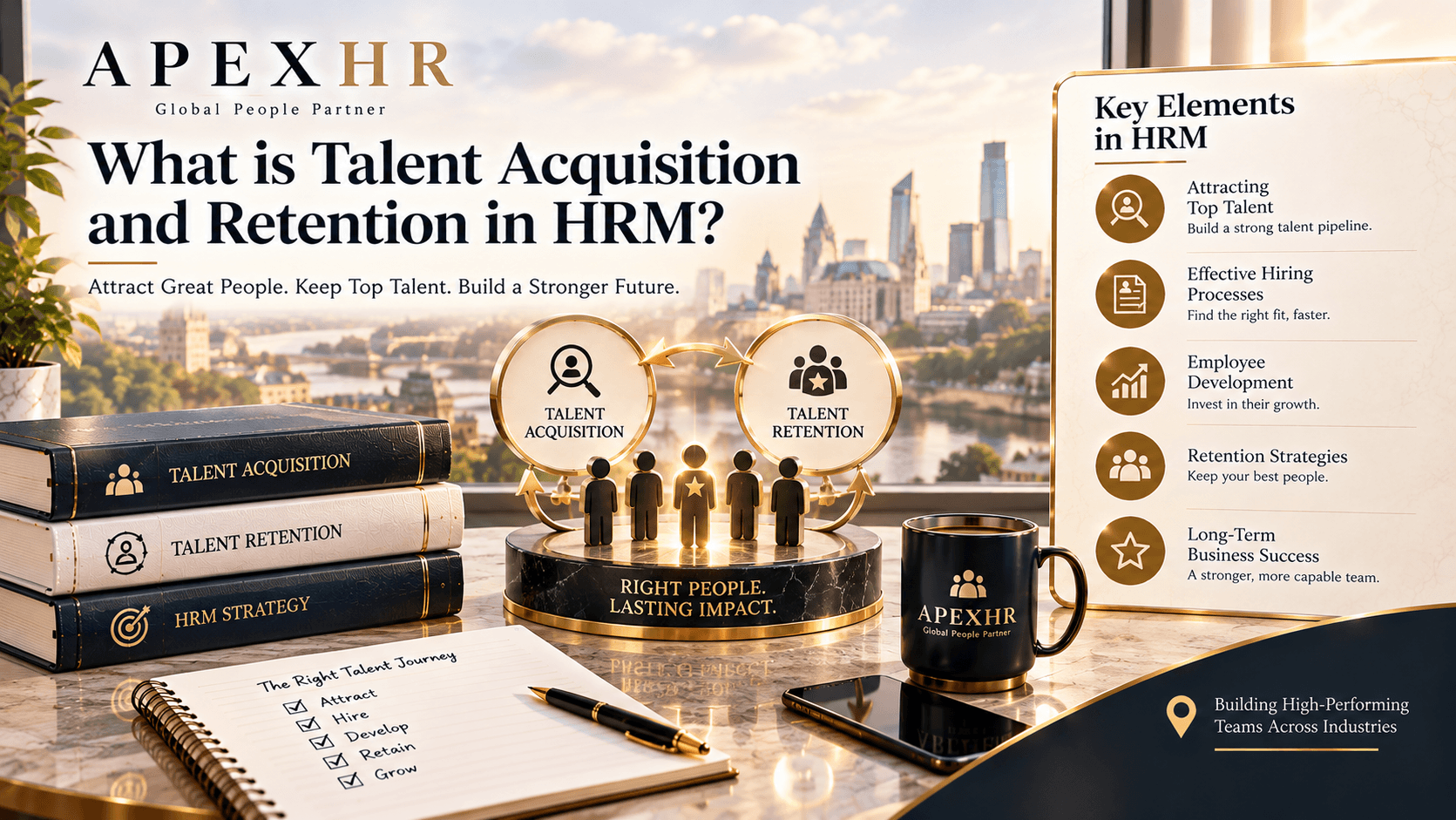
Talent acquisition and retention in HRM are essential to helping UK businesses attract skilled employees, build effective teams and maintain a stable workforce. Apex HR LLC supports employers with recruitment, talent acquisition and wider HR services that help align workforce needs with business objectives. While talent acquisition focuses on identifying, attracting and hiring suitable candidates, […]
Talent acquisition and retention in HRM are essential to helping UK businesses attract skilled employees, build effective teams and maintain a stable workforce. Apex HR LLC supports employers with recruitment, talent acquisition and wider HR services that help align workforce needs with business objectives.
While talent acquisition focuses on identifying, attracting and hiring suitable candidates, employee retention involves creating a working environment that encourages employees to stay, develop and contribute over time. Understanding how these two functions work together can help businesses reduce avoidable turnover, preserve valuable skills and support long-term growth.
Contact Apex HR LLC
Phone: +44 7762 272692
Email: Hello@apexhrllc.co.uk
Address: London, United Kingdom
Website: Apex HR LLC
In This Guide
- What Is Talent Acquisition in HRM?
- What Is Employee Retention in HRM?
- Why Are Talent Acquisition and Retention Important?
- What Is the Difference Between Talent Acquisition and Retention?
- What Is the Talent Acquisition Process?
- What Are the Key Employee Retention Strategies?
- How Can Businesses Align Talent Acquisition and Retention?
- How Can UK Businesses Measure Recruitment and Retention?
- Common Talent Acquisition and Retention Challenges
- How Apex HR LLC Supports Talent Acquisition and Retention
- FAQs About What Is Talent Acquisition and Retention in HRM?
What Is Talent Acquisition in HRM?
Talent acquisition in human resource management (HRM) is the strategic process of identifying, attracting, assessing and hiring people whose skills and experience meet an organisation’s current and future workforce needs.
Unlike recruitment that focuses primarily on filling an immediate vacancy, talent acquisition takes a broader view of workforce planning. It considers the skills a business will need, where suitable candidates can be found and how to build relationships with potential employees over time.
Talent acquisition may include:
- Workforce planning and skills-gap analysis
- Employer branding
- Job design and candidate attraction
- Recruitment marketing
- Candidate sourcing and talent pooling
- Screening and assessment
- Interviews and selection
- Offer management and onboarding
- Graduate and early-career recruitment
- Succession and future talent planning
For example, a growing UK technology business may need to recruit software developers now while building a pipeline of technical specialists for future projects. A structured talent acquisition strategy helps the organisation plan for both requirements.
The CIPD recruitment factsheet explains how effective recruitment supports current and future workforce needs, from defining a role to making an appointment.
What Is Employee Retention in HRM?
Employee retention in HRM refers to an organisation’s ability to keep employees over time by providing a working environment in which people can contribute, develop and see a future for themselves.
Retention is not simply about preventing resignations. It involves understanding why employees stay or leave and addressing workplace conditions that influence those decisions.
Common employee retention activities include:
- Offering fair and competitive pay
- Providing opportunities for learning and career progression
- Supporting effective managers
- Recognising employee contributions
- Maintaining a healthy workplace culture
- Encouraging employee wellbeing
- Providing appropriate flexibility
- Communicating openly with employees
- Addressing workplace conflict fairly
- Conducting stay interviews and exit interviews
For instance, a professional services company may successfully recruit experienced consultants but struggle to retain them because workloads are excessive and career progression is unclear. Improving hiring alone will not resolve the underlying problem.
The CIPD employee turnover and retention factsheet discusses how understanding why employees leave can help organisations develop more effective retention strategies.
Why Are Talent Acquisition and Retention Important?
Talent acquisition and retention are important because an organisation’s performance depends partly on whether it can attract the skills it needs and keep those skills within the business.
1. They Support Business Growth
Businesses need people with the right capabilities to deliver services, develop products and respond to changing market conditions. Strategic hiring and retention help maintain the workforce needed to meet business objectives.
2. They Reduce Avoidable Recruitment Costs
When employees leave frequently, employers may need to repeat advertising, screening, interviewing and onboarding activities.
Although some turnover is expected, improving retention can reduce avoidable replacement costs and disruption.
3. They Preserve Organisational Knowledge
Experienced employees understand internal processes, customer relationships and operational requirements. Retaining this knowledge can support continuity and reduce the learning curve for new starters.
4. They Improve Workforce Stability
A stable workforce can help teams collaborate, maintain service standards and plan workloads more effectively.
5. They Strengthen Employer Reputation
Candidates may consider employee experiences, management practices and career opportunities when deciding whether to apply for or accept a role.
A workplace that treats people fairly and communicates clearly can strengthen its reputation as an employer.
6. They Support Long-Term Talent Development
Retaining employees gives businesses more opportunities to develop internal capabilities, prepare future managers and fill some vacancies through internal progression.
However, retention should not mean keeping every employee regardless of performance or suitability. The aim is to retain valued employees while managing performance and organisational needs fairly.
What Is the Difference Between Talent Acquisition and Retention?
Talent acquisition and employee retention are connected, but they address different stages of the employee lifecycle.
| Area | Talent acquisition | Employee retention |
| Main purpose | Attract and hire suitable people | Encourage employees to remain and contribute |
| Primary focus | Future and immediate workforce needs | Employee experience and workforce stability |
| Typical activities | Sourcing, interviews, selection and onboarding | Development, engagement, recognition and wellbeing |
| Key measures | Time to hire, quality of hire and offer acceptance | Turnover, retention rates and employee feedback |
| Time horizon | From workforce planning through appointment | Throughout employment |
| Desired outcome | Suitable people join the organisation | Suitable employees remain and develop |
Neither function should operate in isolation. Hiring people who are poorly matched to the role or workplace can contribute to early turnover. Similarly, an organisation with a strong retention strategy may still struggle if it cannot attract the skills needed for growth.
What Is the Talent Acquisition Process?
An effective talent acquisition process moves from identifying a workforce need to selecting a suitable candidate and helping that person settle into the organisation.
1. Workforce Planning
The organisation identifies current vacancies, future skill requirements, expected employee departures and areas where additional capability may be needed.
Workforce planning helps employers distinguish between immediate recruitment needs and longer-term talent requirements.
2. Role Definition
The hiring manager and HR team define the responsibilities, essential skills, experience and outcomes expected from the role.
A clear job description and person specification help attract relevant applicants and establish consistent assessment criteria.
3. Candidate Attraction
Employers promote opportunities through suitable channels, such as job boards, professional networks, recruitment agencies, employee referrals and their careers pages.
Employer branding also matters. Job descriptions and recruitment communications should accurately reflect the working environment, responsibilities and opportunities available.
4. Candidate Sourcing and Screening
Recruiters identify potential candidates and assess applications against the role’s requirements.
Depending on the vacancy, this may involve CV screening, application questions, initial conversations, skills assessments or targeted outreach.
5. Interviews and Assessment
Shortlisted candidates are assessed against consistent, job-related criteria.
Structured interviews, relevant work samples and clear scoring criteria can help employers compare candidates fairly and make better-informed decisions.
6. Selection and Job Offer
The employer evaluates the evidence gathered during the process, completes appropriate checks and makes an offer to the preferred candidate.
Clear communication about salary, responsibilities, working arrangements and expectations helps candidates make informed decisions.
7. Onboarding and Early Support
Talent acquisition does not end when a candidate accepts an offer. Effective onboarding helps new employees understand their responsibilities, meet colleagues, access necessary resources and settle into their roles.
Early check-ins can also help identify problems before they contribute to a resignation.
For additional guidance, employers can consult Acas recruitment guidance, which covers practical considerations for recruiting staff fairly and effectively.
Recommended Articles
- Top 10 Permanent Recruitment Agencies in the UK to Compare in 2026
- Cost of Recruitment and Talent Acquisition Services in Leeds: Fees, Models and Hiring Costs
- Cost of Permanent Recruitment in Liverpool: UK Pricing, Fees and What Affects the Price
What Are the Key Employee Retention Strategies?
Employee retention requires more than occasional staff incentives. The strongest approach addresses the factors that influence employees’ day-to-day experiences and longer-term career decisions.
1. Offer Fair and Competitive Pay
Employers should review salary levels, benefits and reward arrangements against relevant market conditions and internal pay structures.
Pay is not the only reason employees stay, but consistently uncompetitive or unfair compensation can make it harder to retain skilled workers.
2. Provide Career Development Opportunities
Employees may be more likely to remain when they can see realistic opportunities to learn, progress or take on greater responsibility.
Businesses can support development through:
- Training and professional qualifications
- Mentoring and coaching
- Career development discussions
- Internal promotion opportunities
- Cross-functional projects
- Leadership development
Where promotion opportunities are limited, employers can still offer meaningful development through expanded responsibilities and specialist learning.
3. Develop Effective Managers
Managers have a significant influence on communication, workload, feedback and the daily employee experience.
Training managers to set clear expectations, address concerns constructively and recognise contributions can help create a more supportive workplace.
4. Recognise Employee Contributions
Recognition should be timely, genuine and appropriate to the employee and situation.
It may involve acknowledging good work, celebrating team achievements, offering development opportunities or providing financial rewards where suitable.
Recognition should also be applied fairly rather than consistently favouring the most visible employees.
5. Support Employee Wellbeing
Unmanageable workloads, poor communication and persistent workplace conflict can undermine employee satisfaction.
Employers should monitor workload pressures, encourage appropriate breaks, provide access to support and address concerns about working conditions.
Wellbeing initiatives are most effective when supported by practical changes to how work is organised.
6. Offer Appropriate Flexibility
Flexible schedules, hybrid working and other arrangements can help employees balance work and personal responsibilities where the role allows.
Employers should communicate the options available, consider requests fairly and apply arrangements consistently with business needs and applicable legal requirements.
7. Build an Inclusive Workplace Culture
Employees should be treated fairly and have clear routes to raise concerns.
Policies addressing discrimination, bullying and harassment should be supported by management accountability, accessible reporting channels and appropriate action when concerns arise.
8. Communicate Career Expectations Clearly
Employees may become frustrated when promotion criteria, performance expectations or future opportunities are unclear.
Regular one-to-one meetings and development conversations help employees understand how their work is assessed and what they can do to progress.
9. Use Stay Interviews and Exit Interviews
Stay interviews explore what encourages current employees to remain and what might cause them to consider leaving.
Exit interviews help identify recurring issues among departing employees. Employers should look for patterns rather than relying on a single interview to explain wider turnover.
10. Review Workload and Work-Life Balance
Persistent excessive workloads can contribute to dissatisfaction and burnout.
Managers should review staffing levels, deadlines, overtime and the distribution of responsibilities. Retention efforts are unlikely to succeed if employees are repeatedly expected to operate beyond reasonable capacity.
How Can Businesses Align Talent Acquisition and Retention?
Talent acquisition and retention work best when employers treat them as connected parts of one workforce strategy.
Recruit for Role and Organisational Fit
Candidates should be assessed against the actual requirements of the job, the team and the organisation. Employers should communicate the realities of the role instead of making promises they cannot deliver.
This helps establish realistic expectations before employment begins.
Make Onboarding Part of the Hiring Strategy
Recruitment teams and line managers should coordinate the transition from offer acceptance to the employee’s first months at work.
A clear onboarding plan can help new starters understand their responsibilities, build relationships and access the support they need.
Use Employee Feedback to Improve Recruitment
If employees repeatedly leave because of unclear responsibilities, limited development or management problems, those findings should inform future recruitment and onboarding.
For example, employers can update job descriptions to clarify workload expectations or train interviewers to explain career progression more accurately.
Develop Internal Talent Pipelines
Businesses should identify employees who may be ready for greater responsibility and provide development opportunities where appropriate.
Internal mobility can support retention while helping employers fill future vacancies.
Share Workforce Data Across HR Functions
Recruitment and HR teams should review relevant data together, including hiring outcomes, probation results, early turnover, employee feedback and exit reasons.
This makes it easier to identify whether recruitment practices and workplace conditions are supporting the same business objectives.
How Can UK Businesses Measure Recruitment and Retention?
Employers should use a combination of recruitment, retention and employee experience measures to assess whether their strategies are working.
| Metric | What it measures | Why it matters |
| Time to hire | Time taken to move a candidate through the hiring process, using a consistent definition | Helps identify delays |
| Offer acceptance rate | Proportion of offers accepted | Highlights possible issues with pay, expectations or candidate experience |
| Quality of hire | Evidence of how well new employees perform and settle into their roles | Helps assess recruitment effectiveness |
| Early turnover | Employees leaving within a defined early-employment period | May reveal onboarding or role-fit issues |
| Employee retention rate | Proportion of employees retained over a defined period | Shows workforce stability |
| Employee turnover rate | Proportion of employees leaving over a defined period | Helps identify patterns in departures |
| Internal promotion rate | Proportion of appointments filled through internal progression | Provides insight into internal development |
| Employee engagement | Feedback about employees’ connection to their work and organisation | Helps identify potential retention concerns |
For example, a business may find that it fills vacancies quickly but loses many new starters within six months. This suggests that recruitment speed alone is not a sufficient measure of success.
Employers should define their calculations consistently and review results by department, role, location and length of service where appropriate. They should also protect employee confidentiality when analysing and reporting workforce information.
Common Talent Acquisition and Retention Challenges
Intense Competition for Skilled Candidates
Specialist roles may attract relatively few qualified applicants. Employers can respond by clarifying essential requirements, broadening appropriate sourcing channels and improving their recruitment experience.
Unclear Employer Value Proposition
Candidates need an accurate understanding of why a role and organisation may suit them. Vague job descriptions or exaggerated promises can create mismatched expectations.
Poor Management Practices
A competitive salary may not compensate for persistent poor communication, unfair treatment or a lack of support from managers.
Limited Development Opportunities
Employees may look elsewhere when they cannot see a path to develop their skills or progress their careers.
Inconsistent HR Processes
Unclear hiring criteria, inconsistent onboarding and poorly managed employee concerns can weaken both recruitment outcomes and retention.
Insufficient Workforce Data
Without reliable information about departures, recruitment performance and employee feedback, employers may invest in initiatives that do not address the actual causes of turnover.
The solution is to identify the underlying problem, agree on realistic actions and measure whether the changes improve outcomes.
How Apex HR LLC Supports Talent Acquisition and Retention
Apex HR LLC supports UK employers with recruitment, HR services and strategic people advice that can help connect hiring decisions with wider workforce needs.
Its Recruitment & Talent Acquisition services cover permanent recruitment, executive search, contract staffing and recruitment process outsourcing (RPO). Depending on the engagement, support can include role definition, candidate sourcing, screening, shortlisting, interview support and onboarding guidance.
Retention may require a different but related set of interventions. Through its wider HR and people services, Apex HR LLC can support employers with areas such as:
- Workforce planning: identifying current and future capability requirements.
- Performance and talent management: establishing clearer performance expectations and development processes.
- Learning and leadership development: strengthening management capability and employee development.
- Compensation, reward and benefits: reviewing pay structures and reward approaches.
- Outsourced HR support: providing practical advice on day-to-day people management and employee relations.
- Employee experience and engagement: helping employers address workforce concerns and improve people practices.
These services can be particularly relevant to small and medium-sized businesses that need experienced HR and recruitment support without building every specialist capability in-house.
Employers can explore the full range of Apex HR LLC services to identify support relevant to their recruitment or retention priorities.
Contact Apex HR LLC to discuss your recruitment, workforce planning or HR support requirements.
Phone: +44 7762 272692
Email: Hello@apexhrllc.co.uk
Location: London, United Kingdom
FAQs About What Is Talent Acquisition and Retention in HRM
1. What is talent acquisition and retention in HRM?
Talent acquisition is the strategic process of attracting, assessing and hiring people with the skills an organisation needs. Employee retention involves creating working conditions that encourage suitable employees to remain, develop and contribute over time.
2. What is the difference between recruitment and talent acquisition?
Recruitment often focuses on filling a specific vacancy. Talent acquisition takes a broader, longer-term approach that may include workforce planning, employer branding, talent pipelines, recruitment and onboarding.
The terms can overlap, and recruitment remains an important part of talent acquisition.
3. Why are talent acquisition and retention important in HRM?
They help organisations secure the skills they need, reduce avoidable turnover, preserve organisational knowledge and build a more stable workforce. Together, they support workforce planning and long-term business performance.
4. What are the five stages of talent acquisition?
A simplified five-stage process is workforce planning and role definition, candidate attraction, sourcing and screening, assessment and selection, and offer management with onboarding. Organisations may divide these stages into more detailed steps.
5. What are the most effective employee retention strategies?
Useful strategies include fair compensation, career development, effective management, employee recognition, wellbeing support, appropriate flexibility, inclusive workplace practices and regular employee feedback.
The right combination depends on why employees are leaving and what matters to the workforce.
6. How can a business measure employee retention?
A business can calculate its retention rate by dividing the number of employees from the starting workforce who remain at the end of a defined period by the number of employees in the starting workforce, then multiplying by 100.
For meaningful comparisons, employers should define the period and calculation method consistently.
7. How can small businesses improve talent acquisition and retention?
Small businesses can clarify job requirements, streamline hiring, provide realistic role expectations, strengthen onboarding, communicate regularly with employees and offer development opportunities that fit their resources.
They can also seek external HR support where internal expertise is limited.
8. Can Apex HR LLC help with both talent acquisition and retention?
Apex HR LLC offers recruitment and talent acquisition services alongside wider HR and people support. Employers can explore its service offerings or contact the team to discuss their specific requirements.
More insights
Related reading
Human Resources
Top Graduate Scheme & Early Careers Consultants in the UK: 15 Options for Employers in 2026
Choosing the right graduate scheme and early careers consultant can help UK employers attract promising graduates, develop future leaders and build a sustainable talent pipeline. Providers differ in their recruitment expertise, university networks, assessment capabilities and ability to manage large graduate recruitment programmes. Apex HR LLC supports employers with tailored recruitment and wider HR solutions […]
Recruitment & Talent Acquisition
RPO vs Recruitment Agency: Which Recruitment Model Is Better for Scaling Teams?
Choosing between Recruitment Process Outsourcing (RPO) and a traditional recruitment agency can influence how effectively a business attracts talent, manages hiring costs and prepares for growth. While both recruitment models help employers find suitable candidates, they differ in scope, responsibilities and how they support an organisation’s workforce requirements. Apex HR LLC supports UK employers with […]
Recruitment & Talent Acquisition
Top 15 Recruitment Process Outsourcing Providers in the UK to Compare in 2026
Choosing the right recruitment process outsourcing (RPO) provider can help UK businesses manage hiring more efficiently, access suitable candidates and improve their recruitment processes. However, providers differ in their service models, industry expertise, technology, geographical coverage and ability to support different hiring volumes. Apex HR LLC supports employers with recruitment and wider HR solutions tailored […]
Talk to Apex HR about your workforce
Whether this raised a question or a decision you're facing, an adviser can help you think it through.